Google Didn't Break Physics: Why AI Exposes the Cloud's Silent Limits
There is a growing narrative in the industry: Google has solved the infrastructure problems that AWS and Azure struggle with. But hyperscalers cannot violate thermodynamics or network physics. AI workloads expose hidden latency boundaries.
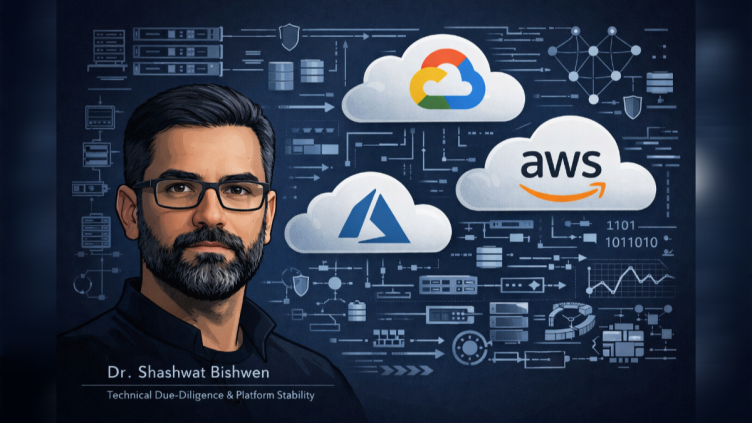
Every few months, marketing departments at cloud hyperscalers announce breakthroughs that supposedly defy the laws of computational physics. Custom silicon, bespoke optical interconnects, and planetary networking fabrics are heralded as the end of latency.
Do not be deceived. Google didn't break physics. Neither did Amazon or Microsoft.
As enterprise AI workloads transition from toy prototypes to continuous production inference, they run squarely into the immutable constraints of thermodynamics, memory bandwidth walls, and speed-of-light propagation across fiber optic networks.
Training and serving large frontier models requires massive parallel tensor communication. The moment data must traverse distributed cluster topologies, interconnect bottlenecks and memory bus saturation immediately assert themselves.
Architects who design AI stacks relying on hypothetical hyperscaler magic find themselves blindsided by staggering latency spikes and eight-figure egress invoices.
Engineering excellence requires designing with physical reality in mind: co-locating data with compute, pruning unnecessary tensor dimensions, and enforcing strict locality of reference.
Frequently Asked
Why do AI workloads expose cloud infrastructure limits that normal apps never hit?
Training and serving large models requires massive parallel tensor communication. The moment data crosses distributed cluster boundaries, interconnect bottlenecks and memory bandwidth walls assert themselves, limits no hyperscaler marketing claim removes.
How do you avoid surprise latency and egress costs when scaling AI infrastructure?
Design with physical reality in mind: co-locate data with compute, prune unnecessary tensor dimensions, and enforce strict locality of reference, rather than assuming hyperscaler custom silicon eliminates the constraint.
Continue the Thread
The Solution Assembler Dispatch
Architectural teardowns, platform stabilization forensics, and cloud FinOps unit economics for founders, CTOs, and board members. Delivered directly to your inbox.