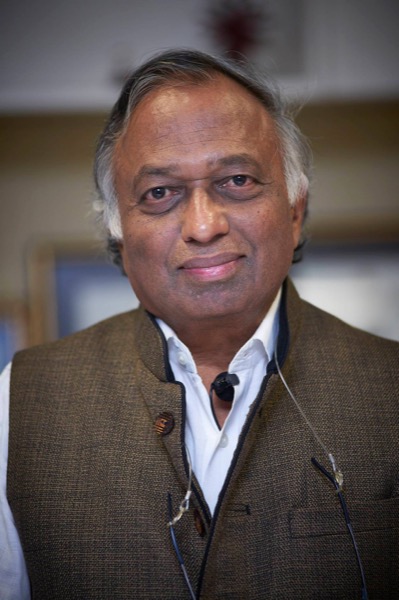
Vijay Bhatkar
Architected India PARAM 8000 supercomputer at C-DAC
“When geopolitical or economic sanctions deny access to proprietary monolithic supercomputers, assemble massively parallel clusters from commodity components.”
The Architectural Breakthrough
In 1988, after the United States blocked the export of a Cray X-MP supercomputer to India for weather forecasting, the Indian government established C-DAC and appointed Dr. Vijay Bhatkar to lead the indigenous supercomputing program. With a fraction of Cray budget and a 3-year deadline, Bhatkar realized building a single giant proprietary processor was unviable.
Instead, Bhatkar pioneered massively parallel processing (MPP) using clusters of Inmos T800 transputers (commodity microprocessors). In 1991, C-DAC unveiled the PARAM 8000. Benchmarks demonstrated that the 64-node parallel cluster matched Cray performance at approximately 5% of the total capital cost.
Connected Advisory & Architecture Research
Cross-Disciplinary LineageBhatkar assembly of the PARAM 8000 using commercial off-the-shelf transputers bypassed international supercomputer embargoes, proving that distributed architectural topology triumphs over proprietary hardware monoliths. This sovereign engineering principle guides our work in When the Cloud Becomes the Single Point of Failure and AI Infrastructure Margin Audits.
Attribution & Historical Context
Bhatkar served as founding Executive Director of C-DAC (Centre for Development of Advanced Computing) in Pune, delivering the PARAM 8000 on schedule in 1991.