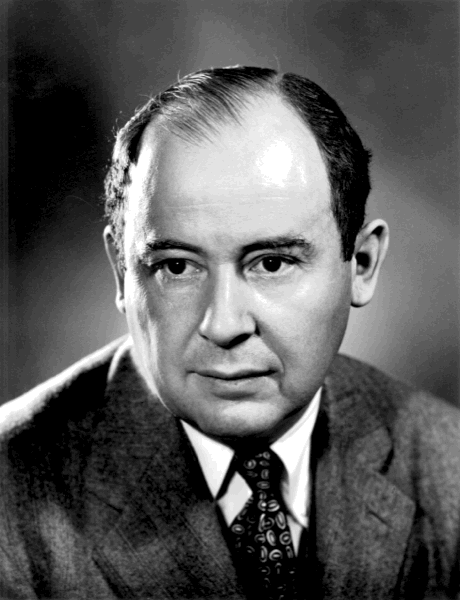
John von Neumann
Stored-program computer architecture (EDVAC report), Game Theory, Cellular Automata
“When compute processing speed outpaces data bus throughput, the transmission channel between memory and processor becomes the sole determinant of system latency.”
The Architectural Breakthrough
In 1945, John von Neumann drafted the First Draft of a Report on the EDVAC, establishing the architectural paradigm where program instructions and runtime data share the same addressable memory. This unified memory model replaced the physical plugboards and manual wiring reconfigurations required by first-generation electronic calculators.
The architecture established five classical functional units: the central arithmetic unit, the central control unit, internal memory, external storage, and input-output channels. While revolutionary, it created the classical von Neumann bottleneck: CPU processing speed is fundamentally constrained by memory bus transfer bandwidth.
Connected Advisory & Architecture Research
Cross-Disciplinary LineageThe von Neumann bottleneck: bus throughput limiting CPU instruction cycles, is now the dominant crisis of AI data centers (HBM bandwidth limits, memory-wall stalls, and bus contention). This constraint dictates the economics explored in The AI Infrastructure Bubble, forensic reviews in AI Infrastructure Margin Audits, and Database Topology Risk Assessments.
Attribution & Historical Context
Von Neumann synthesized ideas developed collaboratively with ENIAC creators J. Presper Eckert and John Mauchly in the First Draft of a Report on the EDVAC (1945).