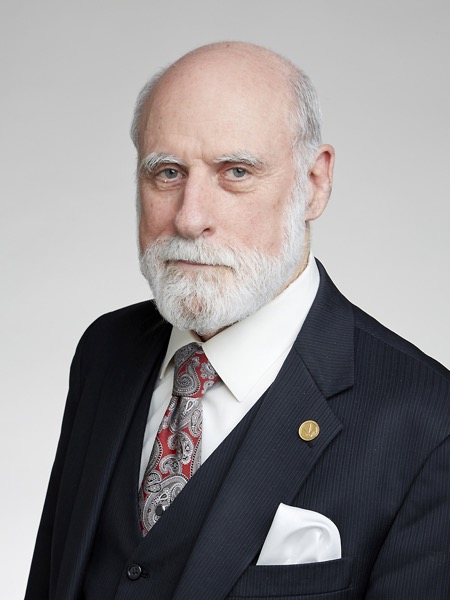
Vint Cerf
TCP/IP transmission control protocol and Internet architecture
“Network intermediaries should remain simple packet forwarders; state tracking, flow control, and error recovery belong at the network endpoints.”
The Architectural Breakthrough
In 1974, Vinton Cerf and Robert Kahn published A Protocol for Packet Network Intercommunication, addressing the challenge of connecting fundamentally different packet networks (satellite networks, packet radio, and terrestrial ARPANET cables).
Cerf and Kahn formulated the end-to-end principle: the intermediate routers of the internet do not need to know the format, meaning, or state of the data they forward. Instead, the transport layer at the receiving and sending endpoints handles packet ordering, acknowledgment, and sliding-window flow control.
Connected Advisory & Architecture Research
Cross-Disciplinary LineageCerf design of the end-to-end principle: keeping the network dumb while placing intelligence, reliability, and retransmission at endpoints, enables modern multi-cloud agility. We assess endpoint autonomy in Enterprise Data Unification Across Legacy Silos and Cloud-Native Platform Interaction-Boundary Reviews.
Attribution & Historical Context
Cerf co-designed TCP/IP with Bob Kahn at DARPA, publishing A Protocol for Packet Network Intercommunication in 1974.