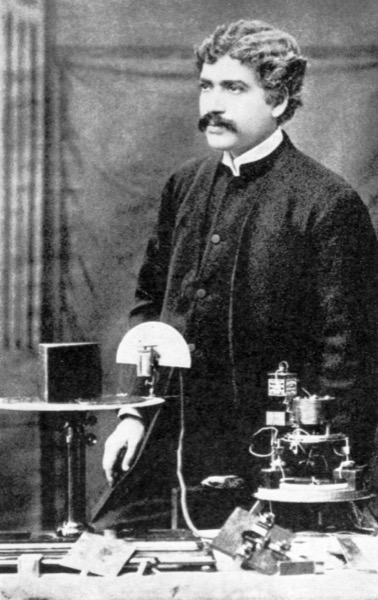
Jagadish Chandra Bose
Millimetre-wave microwave optics (60 GHz), semiconductor crystal detector, and crescograph
“True technological leaps often emerge by repurposing high-frequency physics at empirical fringes where conventional consensus assumes signal propagation is impossible.”
The Architectural Breakthrough
In 1895 at Presidency College in Kolkata, Sir Jagadish Chandra Bose generated and transmitted microwave radio waves at millimeter wavelengths (up to 60 GHz) across fifty feet, penetrating walls and ringing a bell. While Marconi focused on long waves, Bose recognized the precision of high-frequency quasi-optical propagation.
To detect these millimetre waves, Bose developed the Iron-Mercury-Iron Coherer and subsequently invented the Galena (lead sulfide) crystal detector in 1901. This was the world first semiconductor point-contact diode, pre-dating silicon transistor semiconductors by nearly half a century.
Connected Advisory & Architecture Research
Cross-Disciplinary LineageBose pioneering work on millimeter waves (60 GHz) and solid-state semiconductor detectors established the physical underpinnings of high-frequency wireless communications, 5G architectures, and non-contact physical instrumentation. His experimental rigor informs our methodology in The Architecture of Validation: How to Test the Unprecedented and Eliminating Single Points of Failure.
Attribution & Historical Context
Bose demonstrated microwave wireless transmission in Kolkata in 1895 and patented the galena crystal detector in 1901 (US Patent 755,840), refusing commercial royalties to encourage open science.