The Unit Economics of Technical Debt: Where Growth-Stage Platforms Bleed Capital
How to scale multi-tenant architectures past 30M+ users while systematically cutting 28% to 36% of infrastructure drag.
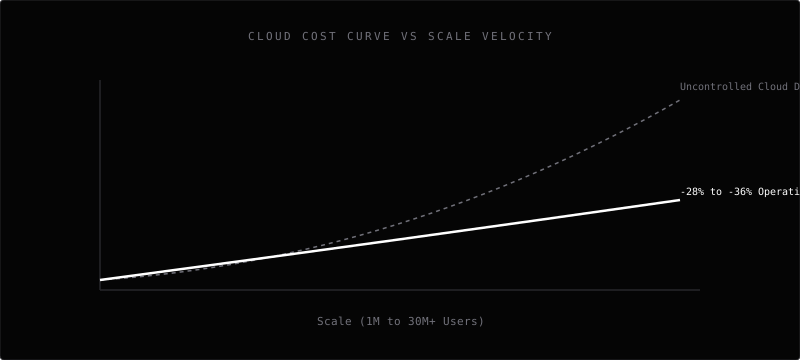
Technical debt is frequently discussed as an abstract code quality issue: messy variable names, missing unit tests, or outdated frameworks. But for CEOs, CFOs, and venture investors, technical debt has a very real, tangible manifestation: gross margin erosion and uncontrolled cloud burn.
During the zero-interest-rate bubble, startups and scaleups masked architectural inefficiencies by simply throwing cloud compute at the problem. If a database query was sluggish, they upgraded to an eight-times-larger RDS instance. If microservices suffered from memory leaks, they added aggressive horizontal auto-scaling rules.
In a disciplined economic environment, this approach is fatal.
When growth accelerates from 1M to 30M users, an architectural inefficiency that cost $2,000 a month quietly explodes into a $150,000 monthly cash bleed. Profit margins evaporate, and the company finds itself subsidizing cloud providers instead of building enterprise equity.
In my work stabilizing large-scale SaaS and enterprise data platforms, we routinely strip out 28% to 36% of total cloud infrastructure spend without degrading platform performance. In fact, throughput and latency almost always improve significantly as a result.
Where does this waste hide? Unindexed Multi-Tenant Database Queries: applications executing full table scans across multi-gigabyte collections under peak load, forcing database clusters to run at 95% CPU utilization. Idle and Over-Provisioned Infrastructure: non-production environments, orphaned block storage volumes, and over-allocated Kubernetes worker nodes running continuously without dynamic scaling controls. Unoptimized Data Ingestion Pipelines: moving uncompressed, unfiltered raw event payloads across cloud availability zones and regions, generating tens of thousands of dollars in unnecessary inter-zone data transfer fees.
By systematically auditing the intersection of architecture and billing telemetry, we can align cloud infrastructure spend directly with revenue-generating activity. Every dollar stripped from unneeded infrastructure burn drops straight to the bottom line.
Frequently Asked
How does a $2,000/month inefficiency become a $150,000/month problem?
The cost scales with user growth, not with the fix. An inefficiency that is trivial at 1M users compounds silently as the platform scales to 30M, and by the time it shows up on the P&L it has grown 75x.
Where does the typical 28-36% of wasted cloud infrastructure spend actually hide?
Three places: unindexed multi-tenant database queries forcing full table scans, idle or over-provisioned non-production infrastructure, and unoptimized data ingestion pipelines moving uncompressed payloads across availability zones.
Solution Assembler, Systems Advisor, TEDx Speaker, and Author. For 24+ years quietly stabilizing platforms, eliminating operational drag, and making broken systems predictable.