The Architecture of Bed Turnover: Why Hospital Capacity Collapses at the Billing Desk, Not the ICU
Hospitals do not run out of beds because they have too many sick patients. They run out of beds because their administrative state transitions are architected as blocking, single-threaded queues.
In distributed systems engineering, there is an iron law: Systems don't fail from load. They fail when they change state.
A database cluster handles high transaction throughput without flinching. The moment you initiate a failover, resize a connection pool, or promote a read replica, the entire system teeters on cascading collapse.
A modern hospital is simply a physical-world distributed system whose nodes happen to be human beings, operating rooms, and inpatient beds. And in every multi-specialty hospital I have audited—from corporate healthcare chains in metro centers to 350-bed regional tertiary facilities across Rajasthan and North India—the state-transition that fails most catastrophically is not the emergency trauma intake. It is not surgical turnover in the OT.
It is the discharge.
Every hospital executive understands Little's Law from queuing theory: L = lambda * W. Average Inventory (Beds Occupied) equals Arrival Rate (lambda) times Average Time in System (W).
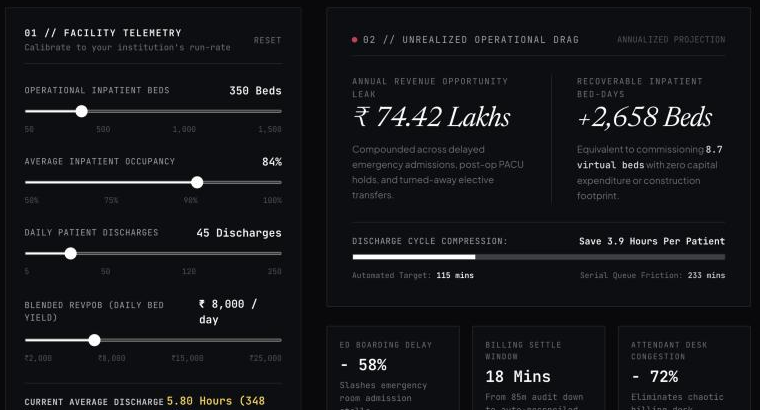
When an inpatient bed is occupied by a clinically recovered patient for 5.8 hours waiting for paperwork, the average time in system inflates artificially. Because total bed capacity is physically bounded by concrete walls, fire regulations, and licensing rules, the only mathematical variable that can give way is the arrival rate.
The emergency department begins diverting ambulances. Elective surgeries scheduled for 11:00 AM sit in pre-op recovery because their post-surgical ward bed has not been vacated. Patients leave Against Medical Advice (AMA) out of sheer exhaustion.
And yet, if you look at the hospital's central management dashboard at noon, the facility is marked at 96% occupancy. To the finance committee, it appears the hospital is operating at peak productivity. In reality, nearly 15% of that capacity is dead weight—producing zero clinical revenue while consuming active nursing attention.
Why does a discharge take 5.8 hours? Because hospital administration designed it as a single-threaded synchronous blocking queue: consultant handwritten ward notes, physical duplicate medicine return chits carried to basement pharmacies, TPA query bottlenecks on insurer portals, crowded queues at the central billing desk, and delayed phone notifications to housekeeping.
Notice something fundamental about these steps: almost none of them have any clinical necessity to occur in series.
The instant a clinical intent to discharge is registered, every administrative department must receive an asynchronous event trigger. Work executes in parallel. Total discharge latency collapses from the sum of all tasks to the duration of the single longest parallel task.
Whenever I speak with hospital managing directors who are frustrated by this gridlock, they tell me: "We are planning to replace our entire Hospital Information System next year." I always urge them to pause.
Rewriting your core hospital software is the single most expensive, disruptive trap in healthcare IT. It takes 18 months. It consumes crores in software license fees and vendor retainers. It alienates senior consultants who refuse to learn new UI paradigms. And worst of all, when the shiny new cloud software finally goes live, you discover that the discharge still takes 5 hours—because the software did not fix the physical paper chits or the serial organizational culture.
You do not need to replace your database. You need to decouple its events. A non-blocking event listener running on an isolated replica can orchestrate parallel human workflows across WhatsApp, SMS, nurse tablets, and insurer portals while your 10-year-old on-premise transactional database hums quietly in the basement without knowing anything changed.
Frequently Asked
Why do discharge delays cause emergency department diversion?
Because inpatient bed capacity is fixed. When clinically cleared patients occupy beds for 5+ hours due to administrative delays, incoming acute patients from emergency have nowhere to be admitted, forcing ambulance diversions.
Why is replacing the entire HIS considered an expensive trap for bed turnover?
Because discharge delays are caused by serial physical handoffs (paper chits, counter queues, manual TPA uploads), not the underlying database engine. A multi-crore EMR rewrite preserves the exact same serial processes unless the workflow itself is decoupled into asynchronous parallel events.
Solution Assembler, Systems Advisor, TEDx Speaker, and Author. For 24+ years quietly stabilizing platforms, eliminating operational drag, and making broken systems predictable.