The Anatomy of a Solution Assembler: Why Systems Fail at the Seams
Why isolated engineering fixes fail without business model alignment and workflow discipline.
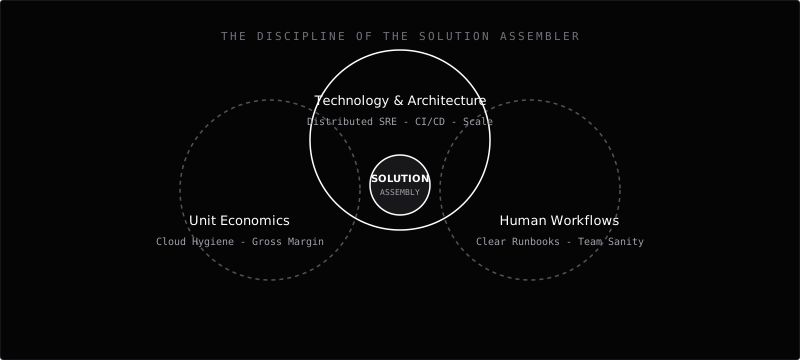
In high-growth companies and scaling enterprises, when a platform starts wobbling under pressure, the default reaction is predictable. Engineering teams clamor for an 18-month ground-up rewrite in a modern language or framework. Concurrently, business leadership demands faster feature velocity, blaming engineering velocity for missing quarterly milestones. Management consultants produce 80-page slide decks illustrating high-level target state architectures.
Yet after eighteen months, millions of dollars in burn, and severe organizational fatigue, the underlying platform fragility remains almost completely unchanged. Why?
Because modern systems almost never fail inside clean, isolated disciplinary boundaries. They fail at the seams.
A platform breakdown is rarely a pure software bug. It is a structural friction point where technology architecture, unit economic incentives, and frontline human workflows are out of alignment.
This is where the discipline of the Solution Assembler begins.
An assembler does not enter an organization with a dogmatic preference for a specific cloud vendor, programming paradigm, or management framework. An assembler looks at the entire system topology, the economic constraints, the data pathways, the deployment pipelines, and the daily friction experienced by frontline operators, before proposing a single line of code.
To assemble a durable solution, three interconnected gears must be brought into lockstep. Technology and Platform Decoupling: surgical intervention to eliminate database bottlenecks, isolate cascading failure modes, and automate release guardrails without halting product delivery. Unit Economics and Cost Hygiene: aligning compute and storage consumption directly with revenue; if platform costs scale faster than active customer volume, the architecture is economically defective regardless of its uptime metrics. Human Workflows and Operational Sanity: if operating a platform requires 2 AM firefighting, manual database patches, or on-call burnout, the system is fundamentally broken.
When you assemble solutions across these three pillars simultaneously, transformation ceases to be a speculative, high-risk gamble. It becomes deterministic engineering.
Frequently Asked
Why do 18-month platform rewrites often fail to fix the underlying problem?
Because the instability was never a pure software bug. It is a structural friction point where technology architecture, unit economics, and human workflows are out of alignment, and a rewrite that only touches code leaves the other two misaligned.
What are the three pillars a Solution Assembler brings into alignment?
Technology and platform decoupling, unit economics and cost hygiene, and human workflows and operational sanity. A platform is only durable when all three move in lockstep, not when any one is optimized in isolation.
Solution Assembler, Systems Advisor, TEDx Speaker, and Author. For 24+ years quietly stabilizing platforms, eliminating operational drag, and making broken systems predictable.